The Water Network ...
Published by Water Network Research, Official research team of The Water Network
The Water Network research team has consolidated an answer to the above question.
Further input from members is welcome and appreciated.
Lead does not react with water under normal conditions. Reactivity will increase if lead comes in contact with moist air beforehand.
Lead removal from water:
· An optimized water treatment process should remove particulate lead.
· Oxidized lead is removed as particles.
· Soluble lead is efficiently removed if raw turbidity is present as it sorbs onto particulate material. With more particles before clarification and filtration, more soluble lead will be removed.
Health effects:
Lead and its components are generally toxic.
Lead negatively affects both the environment and human health.
Concentrations of lead in plants above 500 ppm negatively affect their growth.
Human overexposure to lead causes colics, skin pigmentation and paralysis. Lead poisoning leads to neurological or teratogenic symptoms.
The human body contains 10-20% of lead and women are more susceptible to lead poisoning, while children and absorb as much as 40%.
Elevated lead levels in children cause lower IQ, behavioral changes and concentration disorder.
If in 10% of samples lead levels exceed 15 ppb (µg/L), according to The Lead and Copper Rule , the water utility must reduce the level of lead.
The Lead and Copper Rule has to be respected due to EPA and WHO standards.
Lead gets in drinking water almost entirely from the distribution system.
Lead gets in the water due to corrosion of pipes (an oxidant reacts with iron, lead, or copper) or from brass and solder fittings.
Depending on water chemistry, lead is present in water in a soluble or insoluble form.
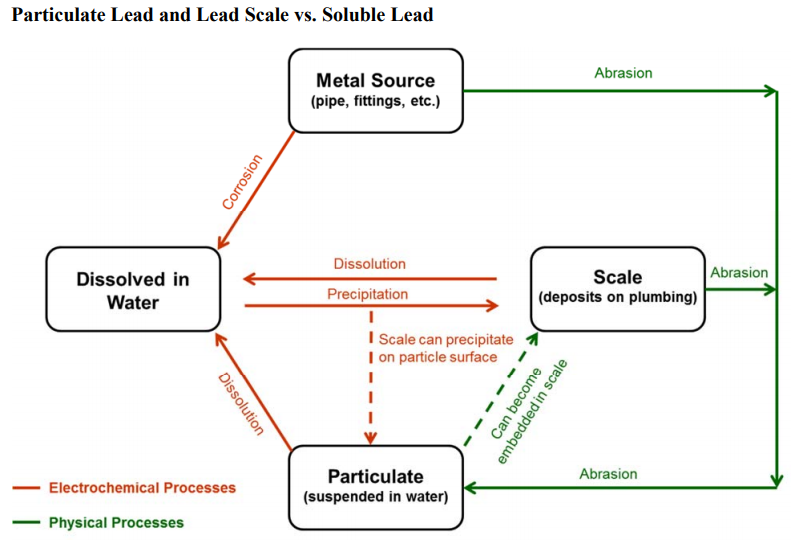
Image: Sources of lead in drinking water
Image source: waterrf.org/PublicReportLibrary/4409.pdf
Soluble lead is dissolved in water.
Insoluble lead precipitates onto the pipe surface.
Controlling lead levels in water:
· Adjusting the water chemistry
· High-velocity flushing to remove particulate lead
· Removing materials in the distribution system that contain lead.
Adjusting water chemistry:
When oxidants react with elemental lead, corrosion occurs.
Pipes are protected in water by the passivation layer – a crust on the inside of the pipes.
Orthophosphate is added to water to create this protective layer.
Orthophosphate bonds with lead in the pipes and creates a coating which protects the metal in the pipes from water by preventing the oxidants from reacting with lead.
The coating has a function only if orthophosphate is continuously added to water . Otherwise, the coating will break and oxidants will react with elemental lead and oxidize it.
Oxidnats can be dissolved oxygen in water or chlorine disinfectant.
2Pb(s) + O2(g) + 2H2O(l) -> 2 Pb(OH)2(s)
Dissolved oxygen in water will react with elemental lead and create lead hydroxide.
Oxidized lead will not stick to the pipes but dissolve in water and contaminate it.
Chloride and chlorine will additionally enhance the corrosion.
Chlorine is the most common disinfectant. Chloride comes from road salt during winter or as ferric chloride used for disinfection.
When the chloride to sulfate concentrations ratio exceeds 0.58, the lead is much more likely to corrode.
Water pH and hardness:
· At pH values below about pH 5, iron, lead, and copper corrode (soluble Pb(II)).
· At pH above 9 these metals are protected.
Higher pH, i.e. higher alkalinity, protects the pipes from corrosion.
Acidic water increases the amount of soluble lead in water as it increases the solubility of lead carbonates which contribute to the protective layer.
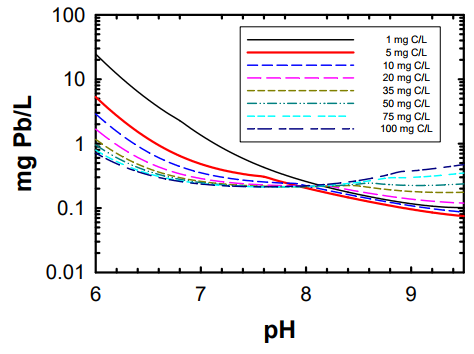
Image: Theoretical impact of pH on lead solubility in drinking water under ideal equilibrium conditions - assumes Pb(II) and no orthophosphate.
Image source: Adapted from Schock and Lytle 2011, waterrf.org/PublicReportLibrary/4409.pdf
Soft water enhances corrosion. In hard water, the amount of lead may be decreased as it will bind with carbonates (PbCO3 or Pb(CO3)22-).
Sources:
· http://www.lenntech.com/periodic/water/lead/lead-and-water.htm
· http://cen.acs.org/articles/94/i7/Lead-Ended-Flints-Tap-Water.html